Iron-Related Bacteria (IRB)
- High levels of a combination of iron, manganese, and turbidity are strong indications that bacterial iron is growing in the well.
- If iron bacteria is detected, then an extra step must be taken. Iron bacteria usually shows up on the report as mild, moderate, or aggressive. Iron bacteria grows in the well and actually eats iron. Oxidizing it will aggravate it. This means that when the iron bacteria comes in contact with oxygen or ozone, this slimy yellow/orange/brown residue gets even worse: it coats the pipes and is not good to consume.
- For mild to moderate iron bacteria, a chlorine injector will treat it.
- The most effective way to treat aggressive iron bacteria is to shock the well once every six months by pouring into the well head one gallon of chlorine for every 50′-100′ of well depth.
TESTING
SEND YOUR SAMPLE TO A LAB
- AM Test Laboratories
13600 NE 126th Pl, Kirkland, WA 98034
Closes 5 PM
(425) 885-1664
http://amtestlab.com - In a bottle no smaller than 250 ml or 8 fluid ounces, draw a sample of water near the source or from the kitchen tap. This sample must be received by the lab within 48 hours of the time the sample is taken, after which time the bacteria will die and can no longer be tested. It might be best to drive the sample directly to the lab. Fill out the sample submission form, and pay $50 with cash, card, or check. It takes ten days for the sample to grow even if the test is negative. The results will be a number. Ideal is zero. Even one is bad, yet even high amounts are treatable.
CONDUCT YOUR OWN TEST
- You can order sensitive iron test strips here: https://www.ebay.com/itm/376239537754
- For an excellent IRB field test kit, order from IRB test; https://cannonwater.com/irb-bart-field-test-kit-for-iron-reducing-bacteria/?searchid=229872&search_query=bart+test. Dave Cannon’s water tech phone number is 916-315-2691.
- The company that makes the IRB test is https://www.dbi.ca/BARTs/IRB.html
TREAT THE WELL
Well Chlorination Preparation:
- Buy jugs of Liquid Pool Shock 12% Chlorine: 1 gallon for every 100′ of well depth.
- Get a hose that will reach from the hose bib nearest the well head to below the wires in the well chamber.
- Designate a large funnel and a hose section long enough to reach below the wires inside the well chamber.
- For protection use rubber gloves, and possibly a mask and goggles if you are afraid of splashing.
Well Chlorination Procedure:
- By-pass all filters.
- Run a hose from the nearest spigot to the well head.
- Place the end of the hose into the well and turn on the water to recirculate the water in the well.
- Slowly add 12% chlorine at 1 gallon per 50-100 feet of well depth. Add a quarter of a gallon at a time.
- When you are able to smell chlorine coming out of the hose fairly strongly, turn off the hose.
- In the house, open up every faucet until you smell chlorine coming out of each faucet.
- Let the lines sit still for 24 hours. Go on a hike, go fishing, spend the evening in a hotel, go have fun somewhere else, but do not run water for 24 hours.
- After 24 hours, turn on all the faucets until the chlorine smell is light or completely gone. This sometimes takes an hour or two.
- At the filter, turn off the by-pass and open the valves to and from the filters, resuming your water to normal use. The house will smell of chlorine for a day or two as the chlorine exits the pipes between the filters and the faucets.
- Repeat this process every 6 months. Spring and fall are the best times.
ADD AN INJECTOR
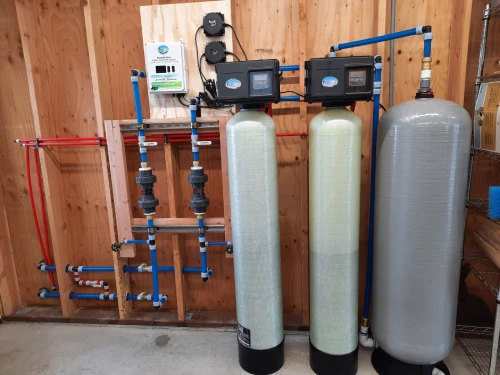
- Adding a chlorine injector in front of the ECOsmarte system is the other way to treat IRB on an on-going basis.
- An alternative to chlorine is hydrogen peroxide, which is more effective than chlorine. You can get a good price from Wesmar Co. Inc. 206-783-5344, ask for April. A 45-pound pail (almost 5 GALLONS) costs $114.00.
https://wesmarcompany.com/ - An injector requires adding diluted chlorine or hydrogen peroxide to the container on a regular schedule. The pump should be monitored periodically because the tubing will eventually need to be replaced.